
 Sharman grew into womanhood with the grace so characteristic of her; it was a given that nature would beautify those startling cheeks and bestow regal assurance upon her tall, intelligent personage. I recall the first time I ever met her: poised eagerly over a first edition of Bleak House, china teacup in hand, she expounded upon the glories of British literature, pausing periodically to brush a curtain of light brown hair away from her face or to replenish her chronically empty cup. A hold-over from the romantic sixties, she was–the 1860s, that is. Having just returned to college from a six week tour of Europe, she was full of Dickens, Stratford-upon-Avon, the Tower of London–anything English. Yes, Italy and France were there–in Italy the men pinched, in France the waiters were rude–but England, ah, England LIVED! Her adoration was infectious, and my own latent anglophilia stirred and expanded, giving me a love for literature–and life–that I had never before known.
Her energy came in spurts and died as quickly as it began. She never seemed to notice how unusual her impulsive behavior was; one minute we might be engrossed in the Victorian essayists, the next we were driving miles to find the perfect hill from which to observe a winter sunset. Once home she would find herself exhausted and spent, and invariably would excuse herself to go and rest. She existed in a rich, overflowing, yet separate sphere, and when she withdrew, it was as if she closed the pages of the book and said, “No more for now.” I always let the cover fall without interference so that she would open the book again. We often took walks in the hills to relieve the strain of studying, and Sharman walked with her entire being. She hungrily absorbed the world around her, taking the birds, flowers and sky unto herself in the manner of a beggar at a feast. Her capacity for appreciation was infinite. Yet, her mood swings were dramatic. I never knew how I would find her–on one occasion, with no apparent provocation, she began contemplating the harshness of life 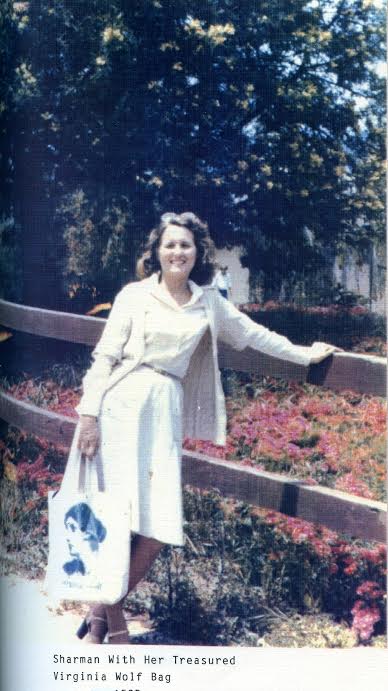 and the injustices of the world, then just as quickly fell into an ecstasy over a recording of Bach fugues we overheard while leaving our rooms.
The entire time I knew her, Sharman never once wore a pair of pants. At first she wore the long “Victorian” dresses popular at the time; she would often place a fresh flower in her long, wavy hair. As time went on, she replaced these items with soft silky blouses and elegant skirts and dresses, and one momentous day the flowing hair vanished; a stylish above-the-shoulders cut had taken its place. From that day on, her perceptive grey eyes became even more intriguing and her confident, knowledgeable lips became alluring and sophisticated.
Sharman often made weekend trips of unknown purpose: to me she would explain that she had decided to fly home at the last minute; curiously, towards others she was more silent. There was something mysterious about her flurried journeys, and she was even more a focus of interest in our little dormitory when she was gone than when she was present. But I defended, excused and protected her extravagant absences; I guarded her privacy as fiercely as she did and although I too wondered where she went (and why), I set that aside in favor of the greater wonder of knowing her friendship.
M y final vision of Sharman remains intact: in front of the small, white wooden chapel she stands, clasping her treasured bookbag–the one displaying Virginia Woolf’s stark, lonely face. Her expressive body leans against the wisteria covered picket fence and that radiant smile emanates, so knowing and self-confident. None of us knew then that she was dying–but she did, of course. That her life was so brief is still unfathomable and that she died on the day she was to have been married was characteristic. She left her vivid legacy with those of us who were graced by her evanescent and memorable life. She is with me yet, her soul touching mine, and when I open a book I feel her presence and see her–teacup in hand, eyes alight–reaching for her own copy, which is most assuredly a first edition.
Cindy C. Lange
http://www.integritasacademy.com

 carried across the pond to the American colonies, where she has steadfastly remained the reigning denizen of early childhood literature. There are several reasons for the unwavering popularity of her verse; investigating them gives insight not only into the poems, but into the nature of children, and more specifically, into the ways in which children can and should develop.
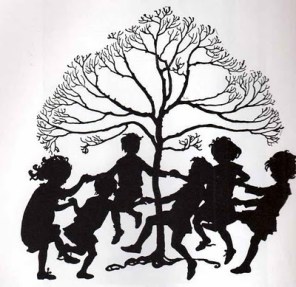 phrase takes the child incrementally from the “known” to the “unknown”—this is foundational to the way that we learn. As they chant, the children run around an object, developing physical abilities in tandem with tonal memory. The content of this rhyme is irrelevant, but the repetitive nature of the words, with their sing-song lilt, provides children with a now-familiar milieu in which to learn; their auditory world becomes a known haven which yields a sense of security through its limited phraseology and repetition, while acting as a vehicle through which they refine their ability to distinguish differences in sounds.




 Freshfirecoal