Parents want to give their children the best education they can and there are two extremes often applied regarding what this means. On the creative, experiential end of the spectrum are parents who focus exclusively on enriching and inspiring their children; on the other end are those who believe that learning must be strictly formulaic. Which is correct?
[Nathan Siemers – Attribution – ShareAlike 2.0 Generic CC
– 5970089724_674349ede7_b_0The answer is neither.]
Students need to be constantly inspired and challenged to investigate the world for themselves, or at best, they will learn to hate school while simply “storing up” information. On the other hand, if children are not given the framework on which to “hang” knowledge, they are not learning at all, but are simply wallowing in a well of self-deception and narcissism.
A classical education is not about learning ancient terminology: it’s about learning to think for yourself, as the classical authors did.
A classical education is not about learning certain facts: it’s about developing a worldview which honors truth and beauty and engenders a love of knowledge.
A classical education is not about competing in the marketplace: it’s about believing that if students are passionate about learning they will be passionate about life and therefore, their vocations will become self-evident.
A classical education is not about believing in “experts” who claim to have grabbed the brass ring, and all you need to do is jump on their merry-go-round and — Voila! your student will be classically educated. Rather, it’s about developing a disciplined, virtuous mind and life. A person’s true vocation and joy in life will be evident if he or she follows this authentic classical path.
True classical scholarship is rare: most of us will never attain it, and that includes the many poseurs in the classical market who purport to have it and attempt to sell it to us. But given a genuine classical philosophy and pedagogy, all students can discover their God-given potential, find their place in the world, and live rich, joyous and successful lives.
There are various approaches to understanding poetry. In the 20th century, the rise of literary criticism began the process teachers now use of analyzing specific literary (rhetorical) devices such as similes, metaphors, etc. to explain the poem. In the 19th century, though, the focus was on having students memorize the poetry and experience the language of the works as a whole. Which approach is best? My answer is both. Memorizing a poem “makes it your own,” but understanding the diction leads you to richer understanding which causes the poetry to enter deeply into your soul.
Today, honors courses require that students take the poems apart rhetorically. This approach to literature, and poetry specifically, is due to the influence of the New Critics, the group of 20th century authors who popularized the idea of literary criticism. They, and their approach, are no longer “in vogue” in universities today, due to the rise of
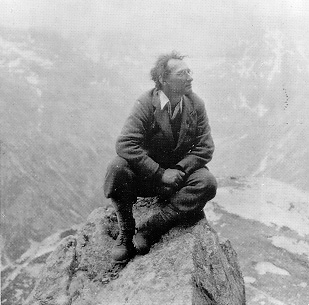
I. A. Richards in the Alps.
Marxist-feminist and other post-modern critical approaches. But in truth, literary criticism as we know it owes its existence to the New Critics such as I. A. Richards, et al, since they taught us how to break apart diction with such careful and specific techniques.
Some assert that analyzing literature rhetorically in this manner “ruins” the enjoyment of it; this is not true. Like any aspect of learning, the more you understand the specifics of the topic, the better you can appreciate its unity. Those who have had negative experiences “digging into” literature have simply had poor teachers who have not successfully passed on the truth that in the humanities, we must comprehend what we read both inductively and deductively, and when a student is challenged to do this, he begins the process of independent thinking, of unifying his thought so as to see the poem as a powerful communicator of truths, both emotional and spiritual.
Let us take Robert Frost’s poem, “Nothing Gold Can Stay,” as an instance of a poem which yields rich results when we “unpack” it rhetorically. Here is the poem:
“Nothing Gold Can Stay” ~ Robert Frost
Nature’s first green is gold,
Her hardest hue to hold.
Her early leaf’s a flower;
But only so an hour.
Then leaf subsides to leaf.
So Eden sank to grief,
So dawn goes down to day.
Nothing gold can stay.
Frost is deceptive. He uses nature to write “beautiful” poetry, but upon examination, we find that his diction is complex, and if we are not extremely careful in approaching the poems, we will be led astray, rather like a detective who is distracted by false evidence, and thus misses the clues which will lead him to discover the true topic at hand.
Although he lived during the time of the development of modern poetry, or “free verse,” which abandoned traditional rhyme schemes and meters, Frost despised this movement. He famously quipped that writing free verse is “like playing tennis with the net down.” In other words, without the rules, there is no poem, no way to create a work of value and structure. Thus, Frost’s poetry is traditional, but deceptively so because of his informal diction; he appears to be holding a conversation with us over the backyard fence or a cup of coffee, when in fact he is always giving us fresh assessments about life and the world, and our relation to it as humans.
After reading the poem out loud, we establish the rhyme pattern. (For those already familiar with these basics, please forgive this brief review.) The rhyme pattern is that referred to as “couplets,” as two consecutive lines rhyme before moving on to the next set of two. Always use lower case letters to show a rhyme pattern, as shown at the end of each line. Frost’s is traditional here, as always:
gold/hold a
flower/hour b (skip the “er” in flower, and read it in the 19th century way, as “flow’r”)
leaf/grief c day/stay d
We engage next with the meter: The rhythm of the poem. Each syllable is stressed or unstressed in our natural speaking manner, creating the “patterns” we know as “meter.” The first and last lines do not line up with the meter of the rest of the poem; lines 2-7 are strictly iambic, but the first and last lines are not. Iambic meter means that the first syllable is stressed, and the second is not. There are two syllables in each “iamb”; each “iamb” is called a “foot.” A poet may have as many “feet” in a line as he chooses. Frost chooses to have three in his lines here, so this is called iambic trimeter.
But let’s get back to the intrigue of those first and last lines not being iambic. Why? The lines have more stressed (emphasized) syllables in them than the iambic lines. When a poet uses stressed syllables in this manner, he is drawing the reader’s attention to these lines. Frost wants us to notice these first and last lines because they are communicating his theme. Additionally, he uses alliteration to pound home the stress: the hard “g” sound in “green” and “gold” wakes us up. Let’s look at the first line:
The emphasized (stressed syllables) are shown in capital letters:
NAture’s first GREEN is GOLD.
Nature, green, and gold are emphasized. We get it that this poem is about nature. But—is it? Why is nature’s first green also gold? Is that true? Nature’s first green is actually in spring. How can green be gold? The leaves turn gold in the fall, right before they die and fall off. So even in the first line, Frost is presenting us with a dilemma—a quandary. Let’s go on and see if we can find some explanation in the next three lines:
Her hardest hue to hold.
Her early leaf’s a flower;
But only so an hour.
Gold is the hardest hue (color) to retain. Why? – because the leaves are dying. While the shimmering gold leaf is the height of beauty, it is also bittersweet; it is a sign of impending death. So, this poem might not be about how beautiful nature is; it might be about something else, such as, perhaps, that death is inevitable. And, not only is death unavoidable: importantly, life’s climax, this nadir of perfect glory, is fleeting, and even as the leaves enjoy their golden glory, they are moving towards death, as we are.
The next line is tricky, but is a continuation of his now clear theme, that life is temporal, and we are all on a journey towards death:
Then leaf subsides to leaf.
The question here is: What does “subsides” mean, in context? It can mean lessen, become less severe, etc. We can discover what Frost means by paraphrasing some: As it dies, one leaf gives way to another leaf which will spring fresh in spring, green and bright. A leaf dies, but it is replaced by another, new leaf: the cycle begins again, and the process repeats itself each year. That’s fine, but – didn’t we already know that? Frost was just laying the groundwork: now he goes on to zing his point home in the last three lines, explaining all in the poem’s “shift”:
So Eden sank to grief,
So dawn goes down to day.
Nothing gold can stay.
Most poems have this “shift”- a point where the author surprises the reader somehow as he changes his viewpoint; it might be a minor twist, or it might be a big one. It’s minor in this poem, if you’ve been paying close attention. Paraphrased, the first of these lines says,
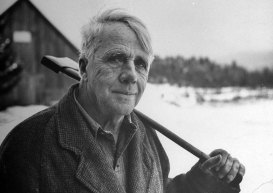
Robert Frost on his land
“In the same manner, death came into the world through the sin of Adam and Eve in the Garden of Eden.” The allusion to Eden encapsulates much, but it’s key to understanding the poem; “thus death came into the world,” as the New Testament says. Notice the word “sank” in the phrase “sank to grief,” which implies that originally, the progression to death did not exist. There was a better world, but we do not live in that world. We must accept not only the mortality of nature in general, but our own mortality.
Although Frost is not religious, he relies heavily upon this Judeo-Christian understanding of the nature of humanity: death entered into the world, and it is inevitable. Think about the line
So dawn goes down to day
Here is another quandary. Shouldn’t dawn be the beginning of day; don’t we say that the sun comes “up”? Isn’t it sunset that goes “down”? Why does dawn go “down” to day? You may already see the answer: because dawn brings forthanother day, time has progressed. The dawn goes “down” not only because it disappears as day springs forth, but because it is another harbinger, a marker on the march of time towards death.
The poem concludes with a strong accent on the word “nothing,” which we now understand much more clearly than we did when we read it as the title:
NOTHing gold can stay.
The unspoken messages are now clear: life is precious, but transient, and we should value every minute, for we do not know when the golden leaves of our lives will drift into eternity. Nature’s first green is gold because the very start of life (spring, green) is also the beginning of our journey towards death—we eventually become “gold,” when we reach our maturity, and then will soon pass from this life to the next. We may or may not believe in the biblical explanation for the brief nature of our lives, but we know that its point is true. And, he implies, if we accept this reality, we will have a better chance of appreciating the life we experience here, before we “shuffle off this mortal coil.”
I teach writing according to the Jane Schaffer writing method, used by high achieving schools in their honors and AP programs. The Schaffer pedagogy meets the definition of “classical” because it leads students into developing critical thinking skills at an early age. Schaffer is qualitatively different from other popular “classical” writing methods, because Schaffer teaches them how to analyze, interpret, and assess ideas. Put another way: students’ minds are engaged in such a manner that they are inspired to develop independent thought. This is because students are led to ponder what a character’s (or historical figure’s) motivations are, or what the consequences of his or her actions or words are, within the context of the theme and diction of the story.
Schaffer is simply a codification of how analytical writing was taught traditionally. As I often tell students, they are like Sherlock Holmes walking onto a crime scene. They must look at the situation presented, as a whole, and from that assess what the important “evidences” are. The Schaffer method calls these “concrete details” (CDs). From there, students use the context of these facts to determine the theme(s) of the text. Why did the author use those facts at that point? Students also bring their own knowledge of life and universal truths to bear on the situation: What is the point of the passage? What does it reveal about the character, or what message is the author communicating to the reader?
When students begin to think analytically, they begin to think independently. Of course, this is the goal of a classical education, not the memorization of a bucketful of facts or texts. The necessity of having such skills before entering the halls of higher education cannot be overemphasized. The Jane Schaffer approach takes time to learn in the beginning–students are building up their “deductive” muscles. But with guidance and practice, they become independent thinkers.
The “method” is a proven way to bringing students’ minds to bear, in order to train them to focus so that they successfully learn the process of analytical reasoning. As students begin to incorporate the techniques so that they think and write inferentially, they no longer need the Schaffer steps, as they have begun the process of independent thinking–the ultimate goal of our educational efforts.
I realize this is a shibboleth among educators today, but I’m going here anyway: recent studies have shown that there is no valid scientific evidence to show that particular students (of any nature) learn better through either an auditory, visual, or a kinesthetic approach. In other words, there are no individual learning modes. As someone who has spent quite a bit of time learning about and teaching special needs students, I do realize that the “received wisdom” in today’s educational community directly contradicts this assertion.
I have always quietly questioned the “learning styles” approach for several reasons. First–and this is purely anecdotal–I have never personally observed any remarkable improvement in a student I have taught due to using lessons which were based on how that student’s learning style had been assessed, even when I was working in special education, applying these lessons diligently.
Second, as a devotee of the Mae Carden philosophy of education (in addition to having attended a Carden school as a child and having received training in the method as an adult), I have absorbed her pedagogy: all students should learn through multiple senses: “reading, listening, speaking, and writing,” as Miss Carden put it. In other words, we develop our intellects by using our various God-given senses. Mae Carden also emphasized individualized learning. By this she did not mean developing an entire new curriculum for each student, but rather, the teacher’s taking the time to work individually with each student. Miss Carden trusted the good teacher to work at finding ways to connect with students. ( I was acquainted with her personally, and know this to be true.) She knew that a teacher who cares about her students will be given the ability to help them when she makes the effort. This is why it is important to keep class sizes small: most classical educators’ experience is that a class which has more than 15 or 16 students is not going to meet the individual needs of students. The teacher simply cannot “divide herself up” during the class period so as to meet the particular questions of students, if the class is large.
My experiences teaching larger classes live online for the past 8 years have borne out this belief. Because my own five children are grown, and because my husband is a surgeon who works long hours, I have had the time to work very long hours in order to give my many online students the individual attention they deserve, through email and phone conversations. However, larger classes are not good, even when the teacher is willing (and able) to give this kind of time commitment, because some students “slip through the cracks” during the class period, and do not learn to interact and grow intellectually through the class discussions. Because I now run my own school, I am able to restrict the class sizes appropriately.
Finally, from a broad philosophical view, the idea that we use multiple senses makes sense, because we all are human beings. That may sound simplistic, but if you think about it, it’s perfectly logical. When teachers engage students by bringing multiple senses to bear, they are teaching the “whole child.” We are whole people, not fractured beings, artificially segmented into disparate parts. It’s not possible to separate out our thoughts and inclinations into neat categories, although it certainly is a temptation!
This is not to say that we do not have different “preferred” styles of learning. I might like to learn by watching videos or listening to audio books, but there is no evidence that I learn better through my preferred modalities. In fact, I may not learn nearly as well through these methods. And this brings up the underlying point: it is a teacher’s job to help a student develop a love for learning, in all modalities; as Carden herself said, “Life is a joy, so should be learning.”
The assertion I am presenting here, while backed up with solid studies, is not popular. The government has learned how to usurp our tax money from us in ways that supposedly help our children who struggle with the accepted public school modes of learning. Other “individualistic” pedagogies popular in the homeschool movement have latched onto the “learning modes” philosophy; finally, well-meaning parents who want to find ways to understand their own children’s struggles have claimed this explanation because they have been duped.
Nothing replaces individual interaction with a dedicated teacher/mentor. In the ancient classical world, those lucky few who were educated had tutors who guided them into learning with personalized attention. For the past century or so, “educators” since John Dewey have been trying to find a magic bullet which will replace this traditional approach. The result has been a disastrous experiment which has damaged our children and our society beyond measure. Unfortunately, many so-called “classical educators” participate in this experiment, either unwittingly or wittingly. There is no replacement, no magic bullet. There is only the difficult but rewarding work of learning how to learn.
As I begin my own live online school, Year of Our Lord 2017, many thoughts come to mind. My involvement in the resurgence of classical education over recent decades has taught me much, both about education and about human nature. And over the past eight years, I was privileged to have been an instructor in two popular online schools, and what a rich education that has been!
Primarily, a cynicism I had developed about American families through my previous teaching experiences–in particular regarding religious and (fellow) homeschoolers, has been replaced by a sense of hope about the future of America and her upcoming generations. Through the hundreds of students and parents I have “met” through teaching live online, I have discovered that there is a deep hunger for genuine learning, framed specifically by the historical Judaeo-Christian tradition which affirms that there IS such a thing as Truth with a capital “T”– that while many in our society wander in the wilderness seeking without finding, truth is, so to speak, in their backyard, if they care to dig it up.
Teachers who want to communicate truth have a heavy burden, for several reasons. First, many of us have had to go back and learn what it means to hold a classical worldview before we can teach it, for we were born at the beginning of our present dark age. Second, although there have been some significant books written about how to re-appropriate the classical canon, we still need to suss this out for ourselves: How do we transmit what it means to be classically educated in this society? As with apophatic theology, which is the defining of God by what he is not, genuine learning might best be described, firstly, by what it is not: it is not a checklist of books, and it is not a codification of learning “methods,” and it is not the memorization of facts.
The Classical World, Marketing & the American Educational Disposition
More apophatic statements: Classical learning is not about grades, or competition in the marketplace: rather, it is a path to enlightenment. Students develop the ability to think for themselves; they grapple with difficult moral dilemmas; they strive for the good and the beautiful; they seek virtue as they engage in, as Mortimer Adler framed it, “the great conversation.”
Another apophatic assertion: if you are listening to videos as a replacement for humanities courses, you are not engaging in that conversation, because just covering the “facts” of the western canon doesn’t teach you how to think; videos have their place, judiciously used, in the classroom, but recorded courses cannot duplicate the experience of interacting, debating, questioning, and growing that occurs among students. The “great conversation” cannot be conducted without live people who engage within the Socratic environment. If you are attempting to become an independent thinker, recordings of this sort will not help, no matter how many so-called “classical” schools market them as a learning tool. What they really are is a way for greedy school owners to make a lot of money without having to pay to engage real teachers in classrooms in real time, with human students, while dealing with all of the attendant problems that come with negotiating with embodied people, not “virtual” life. Schools which provide such videos in place of genuine learning should, at the very least, delete the word “classical” from their marketing and their vocabulary. Let us strive, on our classical journey, to be honest with ourselves and be sure that we do not take shortcuts which are, in fact, wanderings in the educational wilderness.
So students (and teachers, and parents) must first learn how to distinguish the good and the beautiful from the deceitful salesmanship of our present American society, because a classical education is about finding the good and the beautiful, and learning how to love them. This is difficult, and it takes a kind of disciplined effort which is often interrupted (sometimes necessarily) by the distraction of test scores and college requirements, and significantly but unnecessarily, by the slick marketing of some schools which present themselves as classical but all too often are really just repackaged versions of the bureaucratic public school system which has developed in this country; a system which provides false formulaic answers to the nagging question which rightly besets all of those called to the vocation of teaching: How do I pass on to others what it means to think for oneself? And this will be the foremost question for upcoming devotees of genuine classical learning: how to distinguish between and among schools which use the word “classical” as an appeal to gain certain clientele, and those which rightly and truly practice the classical way: that of teaching students to think for themselves in the light of Truth. (May 2017)
You early few who “slipped the surly bonds of earth”
but were flung back to us, intact;
You high-flying heroes, Ulysses of the skies,
Returned to the wine-dark sea;
Unlike Icarus, you prevail.
Forever may you climb in silver splendor.
That demarcation line between sunshine and shade,
Dividing the fog of breath from the still of death,
Is where I sometimes exist.
Shadows slip inside and encapsulate;
They know the dark.
But high places beckon, and like a Narnian ghost
I welcome that which is beatified~ even the shadows.
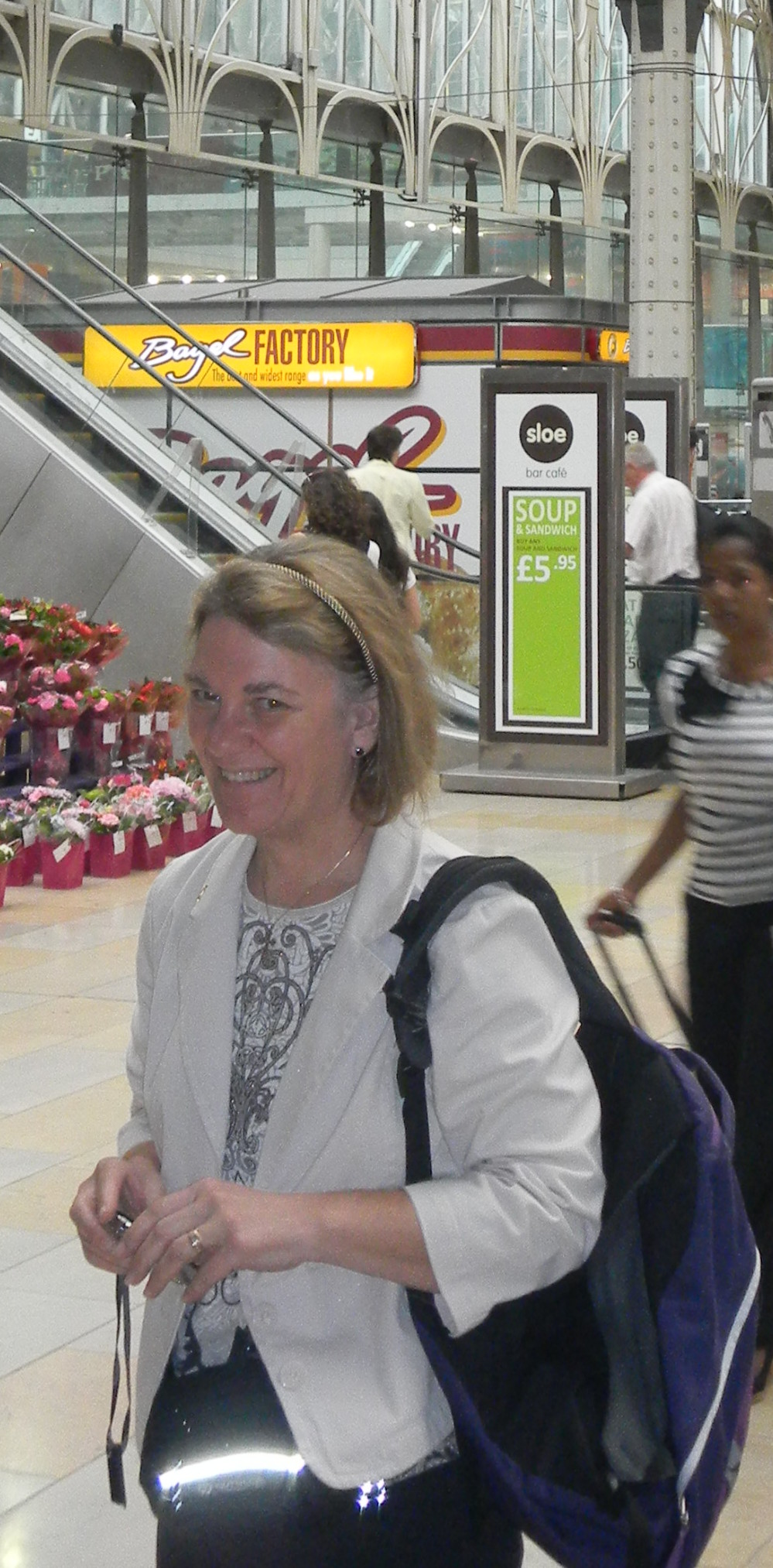
Last Tuesday we took the train from Oxford to Paddington Station in London in order to spend the day at the Royal Observatory. We arrived at Paddington Station, blissfully unaware that I would spend most of the ensuing hour trapped in a cubicle in the nearby loo. As Adrian Monk would say, “Here’s what happened”:
I go to the loo, which is underground, and has 8 or 10 cubicles in it. I shut the door to the cubicle, sliding the metal bar through the hardware on the frame next to the door. When I subsequently try to open it, it won’t budge, because the bar has lost its moorings and has jammed, unable to center itself enough to be pulled out. I try adjusting it, attempting to keep it centered with a fingernail file, but– no go. Then I decide I will have to crawl under the door, and I look down, but there is a clearance of only about 4-5 inches between the door and the floor. I’ve recently lost some weight—but not that much! Then I think of crawling over the wall to the next cubicle, but the walls are so very tall that this would be a challenge—though perhaps not an impossibility, if there were no other alternative: Maybe I could somehow rig my backpack up on the door as a way to pull myself up, using the slanted toilet paper holder as a foothold?
Before trying this, though, I call out and ask the (very nice but completely flummoxed) Pakistani attendant to help me. I tell her that I need a screwdriver, because I can see that I could take the simple latch off in a jiffy, if I had one. She does not feel that she has the authority to do this–or perhaps she does not know the word screwdriver in English—I’m not sure. . . so she calls a (male) supervisor in. He comes, but has no screwdriver with him. Apparently he does not know what to do, although by this time I am calling out frantically and repeatedly, “Just get me a screwdriver!” The Pakistani attendant tells me they are, but by now, 15 minutes have gone by, and I’m beginning to worry. I try calling John but the phone won’t connect, as the loo is underground. So, I breathe a prayer and text him…this works. I tell him my situation, and he texts back how funny it is that we have the technology to text each other but they can’t get me a screwdriver. Yeah, hilarious–a real belly laugh.
I keep banging on the door, demanding a screwdriver, exaggerating my upset emotional state. The woman in the stall next to me says, “Calm down!” I say, “Don’t tell me to calm down!” YOU calm down!” I feel that the time for reasoned, measured discussion is over. Next, the attendant and the supervisor call ANOTHER (male) supervisor. I continue to aggressively pound on the door, while sticking my foot on the bottom, rattling it in an annoying manner, so people will notice me, and calling out, “I JUST need a screwdriver and I can be out of here in less than a minute!” A second supervisor comes, but I don’t know this—the attendant continues to tell me that they are getting a screwdriver, which is not actually the case. Unbeknownst to me, they are simply standing there, gawking at the broken cubicle, doing nothing. John texts me again, “Do you need me to do something?” I text back that I may, but I will wait a couple of more minutes, since I am foolishly believing the attendant’s false promises. My annoying pounding and yelling continues for a total of a half an hour, perhaps longer. Finally, just as I am ready to tell John to come on down (and he would have), the hand of a fellow traveler appears under the door and offers me a Swiss Army knife with the screwdriver attachment open. I grab it and in 30 seconds or less have taken off the offending latch. The kindly Pakistani attendant is standing on the other side of the door, saying, “Something will have to be done on this side, also, for you to get out,” but I open the door, and simply and shakily step to freedom. I hand the Swiss Army knife back to the clever and helpful woman who loaned it to me, thanking her, and assuring the apologetic attendant that it’s ok. As I look up towards the door, I see two males in uniforms standing there, staring at me—the supervisors, who clearly are NOT Pakistani and do speak English. I glare at them and pointedly declare, in a stentorian tone, “Don’t you know what a screwdriver is?” two times, and stomp up the stairs, relieved to be surrounded by the blessed cacophony of Paddington Station.
The first thing I’m doing when we return home is buying a Swiss Army knife, which will permanently reside in my purse. I’m still deciding what color I want; (John’s is red, so I’ll choose something different) and what features to include, but the screwdriver attachment is NOT optional. I can’t imagine how I’ve survived without it all these years.


 want to give their children the best education they can and there are two extremes often applied regarding what this means. On the creative, experiential end of the spectrum are parents who focus exclusively on enriching and inspiring their children; on the other end are those who believe that learning must be strictly formulaic. Which is correct?


 interpret, and assess ideas. Put another way: students’ minds are engaged in such a manner that they are inspired to develop independent thought. This is because students are led to ponder what a character’s (or historical figure’s) motivations are, or what the consequences of his or her actions or words are, within the context of the theme and diction of the story.
 is the point of the passage? What does it reveal about the character, or what message is the author communicating to the reader?



 student, but rather, the teacher’s taking the time to work individually with each student. Miss Carden trusted the good teacher to work at finding ways to connect with students. ( I was acquainted with her personally, and know this to be true.) She knew that a teacher who cares about her students will be given the ability to help them when she makes the effort. This is why it is important to keep class sizes small: most classical educators’ experience is that a class which has more than 15 or 16 students is not going to meet the individual needs of students. The teacher simply cannot “divide herself up” during the class period so as to meet the particular questions of students, if the class is large.
 evidence that I learn better through my preferred modalities. In fact, I may not learn nearly as well through these methods. And this brings up the underlying point: it is a teacher’s job to help a student develop a love for learning, in all modalities; as Carden herself said, “Life is a joy, so should be learning.”
 which has damaged our children and our society beyond measure. Unfortunately, many so-called “classical educators” participate in this experiment, either unwittingly or wittingly. There is no replacement, no magic bullet. There is only the difficult but rewarding work of learning how to learn.
 recordings of this sort will not help, no matter how many so-called “classical” schools market them as a learning tool. What they really are is a way for greedy school owners to make a lot of money without having to pay to engage real teachers in classrooms in real time, with human students, while dealing with all of the attendant problems that come with negotiating with embodied people, not “virtual” life. Schools which provide such videos in place of genuine learning should, at the very least, delete the word “classical” from their marketing and their vocabulary. Let us strive, on our classical journey, to be honest with ourselves and be sure that we do not take shortcuts which are, in fact, wanderings in the educational wilderness.




 attachment open. I grab it and in 30 seconds or less have taken off the offending latch. The kindly Pakistani attendant is standing on the other side of the door, saying, “Something will have to be done on this side, also, for you to get out,” but I open the door, and simply and shakily step to freedom. I hand the Swiss Army knife back to the clever and helpful woman who loaned it to me, thanking her, and assuring the apologetic attendant that it’s ok. As I look up towards the door, I see two males in uniforms standing there, staring at me—the supervisors, who clearly are NOT Pakistani and do speak English. I glare at them and pointedly declare, in a stentorian tone, “Don’t you know what a screwdriver is?” two times, and stomp up the stairs, relieved to be surrounded by the blessed cacophony of Paddington Station.
 Freshfirecoal